
A homeowner in Mission Hills notices a large black bee hovering near the eaves of a cedar-shake roof every morning in May, then discovers a perfectly round half-inch hole drilled into the rafter tail beneath the overhang. A homeowner in Armour Hills finds a pile of fine sawdust on the patio directly below the wood fascia, looks up, and counts six similar holes along the board. A homeowner in Leawood with a newer metal-roofed house has never had the problem at all, and does not understand why the neighbors do. Kansas City pest control providers who work carpenter bee calls, including ZipZap Termite & Pest Control in Lawson, see the same construction-driven pattern every spring. The species strongly prefers certain types of wood exteriors, and the housing stock most affected in the metro is predictable by neighborhood and by era.
The Species and How It Differs From Bumble Bees
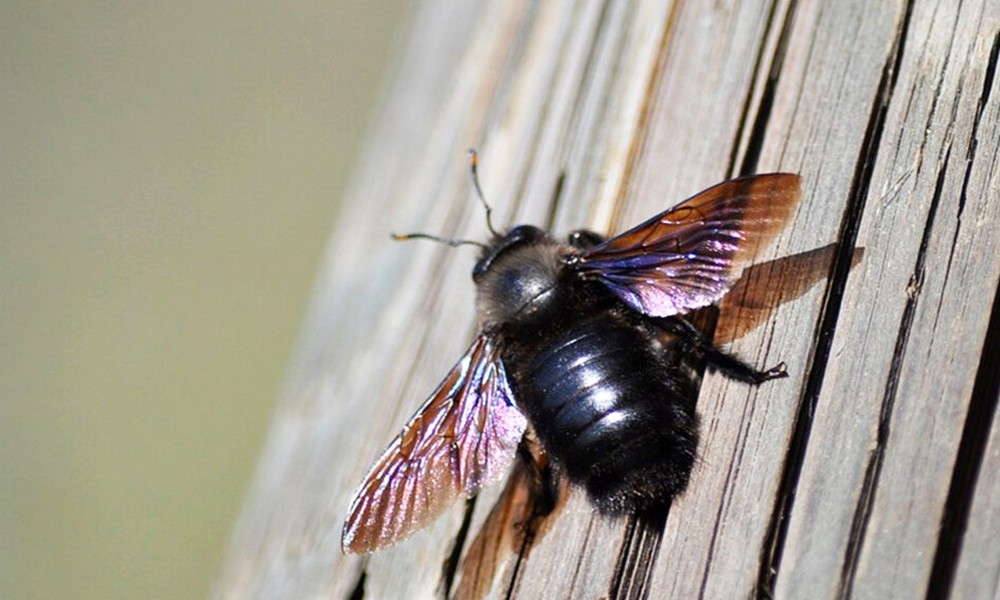
The eastern carpenter bee (Xylocopa virginica) is the species responsible for nearly all carpenter bee damage in Kansas City. Adults are large, about 3/4 to 1 inch long, with a shiny black abdomen and yellow and black markings on the thorax. The shine of the abdomen is the single most reliable field identification: bumble bees, which are the species carpenter bees are most often confused with, have a fuzzy, hair-covered abdomen rather than the smooth black carapace of a carpenter bee.
Behavior also differs. Bumble bees are social, nest in the ground or in abandoned rodent burrows, and are rarely seen around house exteriors. Carpenter bees are solitary, nest in wood, and are the species hovering around eaves and fascia in May. Males hover aggressively and will approach any moving object near the nest site, but male carpenter bees cannot sting at all. Females can sting but almost never do unless physically handled.
Honey bees, which occasionally get confused with either species, are substantially smaller (about half an inch), brownish rather than black, and live in colonies inside tree hollows or managed hives.
What Carpenter Bees Actually Do to Wood
The damage is distinctive. Females drill a perfectly round entry hole approximately 1/2 inch in diameter into softwood surfaces, then tunnel inward for about an inch before turning 90 degrees and tunneling along the wood grain for several additional inches to create a gallery. The gallery becomes the nest, subdivided into individual cells where eggs are laid and provisioned with pollen.
First-year damage on a new piece of wood is usually modest, a single entry hole and a short gallery. The compounding damage comes from subsequent years. Carpenter bees are philopatric, meaning they return to the same nest sites year after year, and new females often extend existing galleries or drill adjacent entries. A rafter tail that has been colonized for ten years can contain a complex gallery system measuring several feet in total length, with corresponding loss of structural wood.
The frass ejected during tunneling is the other diagnostic sign. Fine yellowish sawdust mixed with fecal material accumulates on surfaces directly below active holes, often visible on siding, patios, decks, or window sills.
Woodpeckers are an additional consequence. Downy and hairy woodpeckers identify carpenter bee galleries and drill into the wood to access the larvae, producing large ragged holes that are dramatically more damaging than the original bee activity. A homeowner who sees fresh woodpecker damage on a fascia board in June is almost always looking at a secondary result of carpenter bees that established weeks earlier.
Why the Construction Matters So Much
Carpenter bees target specific wood conditions. The combination of characteristics on certain Kansas City homes is almost ideal for the species.
Unpainted or weathered softwoods are the strongest attractant. Cedar, redwood, pine, fir, and cypress are all readily excavated. Hardwoods are rarely attacked.
Wood surfaces without paint or heavy stain. A freshly painted surface resists carpenter bee drilling meaningfully, but the protection degrades as paint weathers and bare wood becomes exposed at edges, joints, and knot areas.
Horizontal or near-horizontal surfaces under protection. Fascia boards, rafter tails exposed under eaves, horizontal trim boards, window boxes, deck railings, and the underside of overhang beams all fit the preference pattern. Vertical siding alone is less preferred than horizontal edges.
Older neighborhoods in Kansas City with significant cedar shake roofing, exposed rafter tails, wood soffits, and cedar siding, including Mission Hills, Armour Hills, Brookside, Prairie Village, Leawood’s older sections, and similar mid-century neighborhoods, show the highest carpenter bee activity in the metro.
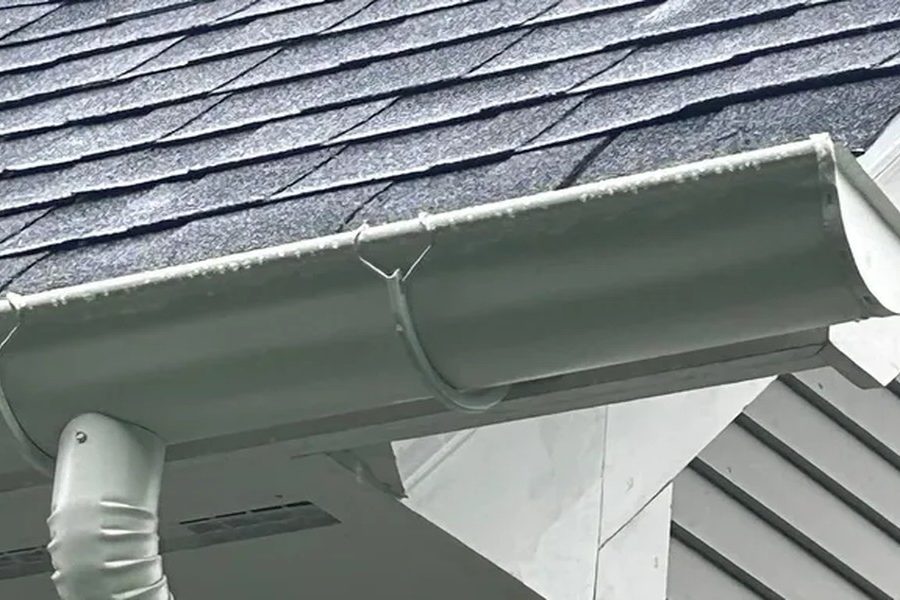
Homes with newer construction using fiber cement siding, metal fascia, composite trim, or enclosed soffits present almost no carpenter bee vulnerability because the preferred target material is not present.
Why Spraying Around the Entry Is Not the Treatment
A homeowner spotting a carpenter bee hole and reaching for a wasp and hornet spray typically produces minimal results. The bee that was flying around the entry is temporarily dispersed, but the gallery continues to host eggs, larvae, and returning females.
Effective treatment applies an insecticide dust directly into the entry hole, not a spray around it. Dust formulations such as deltamethrin dust or boric acid dust work because the bees contact the dust as they enter and exit, carrying it through the gallery and distributing it to the eggs and larvae inside. A squeeze-bottle dust applicator inserted into the entry hole delivers the product where it actually reaches the population.
After dusting, the holes should remain open for several days to allow the remaining bees to contact the treatment during their normal entry and exit. Sealing the holes immediately traps the bees inside with the eggs and larvae, which produces short-term satisfaction but not full control because any unaddressed galleries nearby continue to be active.
Final sealing is appropriate after the dust has circulated for about a week. Wood putty, caulk, or dowel plugs seal the entry and prevent reuse by returning females the following year.
Long-Term Prevention Through Building Changes
Treatment kills the current generation, but carpenter bees return to structures that remain attractive. Several building changes produce durable prevention.
Painting or heavily staining all exposed softwood surfaces. Paint provides the strongest deterrent, and maintaining the paint as it weathers is the most consistent long-term fix.
Replacing preferred materials with carpenter-bee-resistant alternatives. Aluminum fascia, vinyl soffit, fiber cement trim, and composite lumber all eliminate the attractant entirely.
Metal flashing on vulnerable edges. The leading edge of cedar shake roofs, the top of fascia boards, and exposed horizontal surfaces under eaves can be protected with thin metal flashing that eliminates the bee’s preferred drilling surface without requiring full material replacement.
Aggressive sealing of weather checks, knot holes, and existing damage. Smaller defects in otherwise sound wood become future entry points if left unsealed.
When Kansas City Pest Control Involvement Makes Sense
Active carpenter bee populations on a home warrant professional treatment when multiple entries are present, when the damage has extended beyond a single board, when height or access makes treatment difficult, or when woodpecker activity has already begun creating secondary damage. A Kansas City pest control provider can complete the dusting and monitor the population across multiple treatment cycles that a homeowner on a ladder usually cannot.
The Short Version
Carpenter bees target softwood surfaces on older Kansas City homes with wood-shake roofs, cedar siding, and exposed rafter tails, and the damage compounds over years as returning females extend existing galleries. Treatment is dust applied directly into the entry holes rather than surface spraying, followed by sealing after a week of circulation. Long-term prevention comes from painting, material replacement, or metal flashing on vulnerable edges. For homeowners in older neighborhoods with significant carpenter bee activity, a Kansas City pest control provider such as ZipZap Termite & Pest Control can complete the treatment cycle and help plan the structural changes that make the problem stop recurring.